Enhanced catalytic reduction of p-nitrophenol on ultrathin MoS2nanosheets decorated noble-metal nanoparticles
Xiu-Qing Qiao, Zhen-Wei Zhang, Feng-Yu Tian, Dong-Fang, Hou, Zheng-Fang Tian, Dongsheng Li, and Qichun Zhang
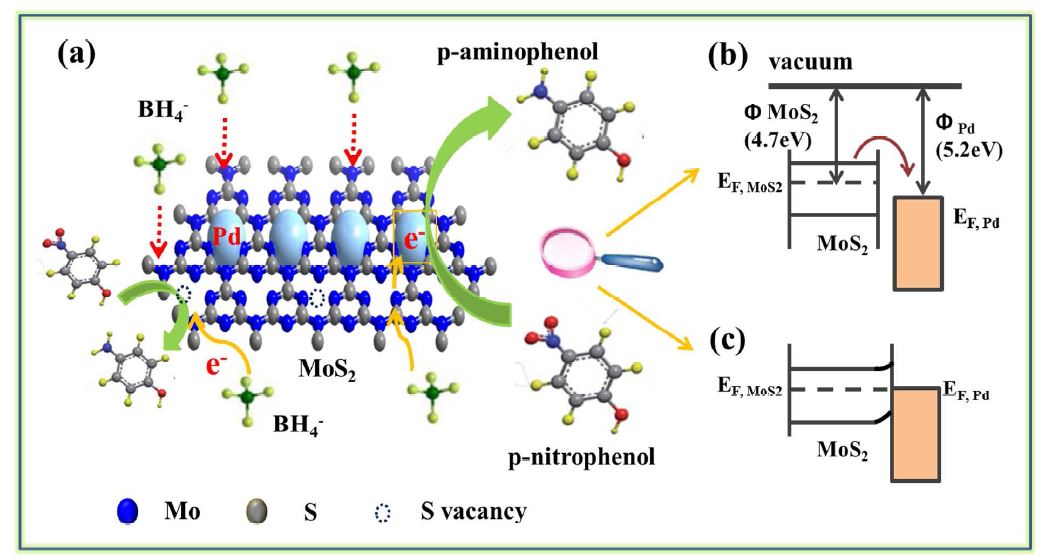
ABSTRACT: In this work, ultrathin MoS2nanosheets (MoS2NSs) with defect-rich structure were prepared and used as catalysts for the reduction of p-nitropheonol. Also, thanks to the defect sites, noble metal (Au, Ag, Pd, Pt) nanoparticles (NPs) can successfully deposited on the MoS2NSs via a facile and efficient one-step photochemical reduction process without the assistance of stabilizer. The morphology and crystal structure of as-synthesized materials were characterized by X–ray diffraction (XRD), scanning electron microscopy (SEM), transmission electron microscopy (TEM), X-ray photoelectron spectroscopic (XPS) and N2physisorption mearurements. Catalytic results demonstrate that as-prepared MoS2NSs and noble metal modified MoS2NSs (NM/MoS2NSs) effectively catalyze the reduction of p-nitrophenol (p-NP) to p- aminophenol (p-AP) with NaBH4. The Pd/MoS2NSs shows the best catalytic performance, exhibiting an apparent rate constant (κapp) of 0.386 min-1even with moderate chemical stability. Interestingly, the activity of MoS2NSs is comparable and even higher than previous studied noble metal-based catalysts. Moreover, the good reusability without significant activity loss suggests that MoS2NSs can be a strong candidate for sustainable chemical catalysis. The origins of the high catalytic activity are also discussed and a probable reaction mechanism is suggested. The present work opens up new opportunities for the future design and fabrications of versatile MoS2-based composite materials.