Bi-Microporous Metal-Organic Frameworks with Cubane [M4(OH)4] (M = Ni, Co) Clusters and Pore Space Partition for Electrocatalytic Methanol Oxidation Reaction
Ya-Pan Wu, Jun-Wu Tian, Shan Liu, Bo Li, Jun Zhao, Lu-Fang Ma , Dong-Sheng Li*, YaQian Lan, Xianhui Bu
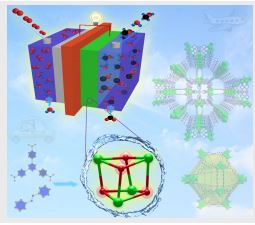
Abstract: Embedding catalytically active inorganic components within matrices of metal-organic frameworks (MOFs) is a strategy to develop materials with unprecedented synergistic properties. Of particular interest are transition-metal-cluster-based materials, due to their potential for structural robustness and high electrochemical activity. Even though tetranuclear clusters are common in MOFs, cubane [M4(OH)4] (M = Ni, Co) based MOFs are rare, hampering the investigation into their applications such as electrocatalysis. Herein, through an ingenious scheme of tri-component charge matching, in conjunction with size/symmery matching, a new material type based on pore-space partition of the cubic primitive minimal-surface net (MOF-14-type) have been realized. CTGU-15 made from [Ni4(OH)4] cluster not only has very high BET surface area (3537m2 /g), but also exhibits bi-microporous feature with well-defined micropores at 0.86 nm and 1.51 nm. It is an unusual example of pore space partition by a ligand pair, in contrast to the single-ligand pore-space-partitioned trimer-based pacs type. Furthermore, CTGU-15 is stable even under high pH (0.1M KOH), making it well suited for methanol oxidation in basic medium. The optimal hybrid catalyst KB&CTGU-15 (1:2) made from ketjen black (KB) and CTGU-15 exhibits an outstanding performance with a high mass specific peak current of 527 mA mg−1 and excellent peak current density (29.8mA·cm-2 ) at low potential (0.6V).The isostructural cobalt structure (CTGU-16) has also been synthesized, further expanding the application potential of this material type.
文章链接:https://onlinelibrary.wiley.com/doi/abs/10.1002/ange.201907136