Tunable MoS2/SnO2P-N Heterojunctions for Efficient Trimethylamine Gas Sensor and 4‑Nitrophenol Reduction Catalyst
Xiu-Qing Qiao, Zhen-Wei Zhang, Dong-Fang Hou, Dong-Sheng Li*, Yunlin Liu, Ya-Qian Lan,Jian Zhang,Pingyun Feng and Xianhui Bu
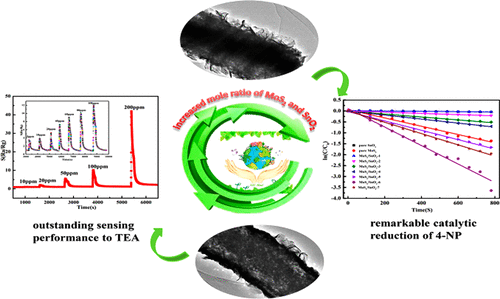
Synthetic design and construction of P-N heterojunctions are attracting increasing attention due to their potential applications such as catalysis, gas sensor, energy storage and conversion. In general, the design strategies of P-N heterojunctions target one specific property. The construction of multifunctional materials with different functions remains an interesting and challenging research pursuit. Especially, multifunctional properties switched within a given chemical combination remain has been rarely known. Herein, by adjusting the mole ratio between MoS2and SnO2, the first bifunctional MoS2/SnO2P-N heterojunctions have been realized within a particular chemical system. As a result of the combination of MoS2nanosheets and SnO2nanofibers, MoS2/SnO2heterojunctions exhibit great potential in both gas sensor and catalyst. With low loading of MoS2(molar ratio, Mo/Sn=0.53), the P-N heterojunction exhibits superior sensing selectivity and long-term stability toward trimethylamine. With increased MoS2amount, the P-N heterojunctions display very good catalytic activities for 4-nitrophenol reduction. The bifunctional MoS2/SnO2P-N heterojunctions with high sensitivity, selectivity, stability and catalytic activity are promising candidates for practical applications. It can be anticipated that the synthetic strategy reported here will create new opportunities for realizing multifunctional materials by the rational design of P-N heterojunctions.
文章链接:https://pubs.acs.org/doi/abs/10.1021%2Facssuschemeng.8b02842